

Kamil
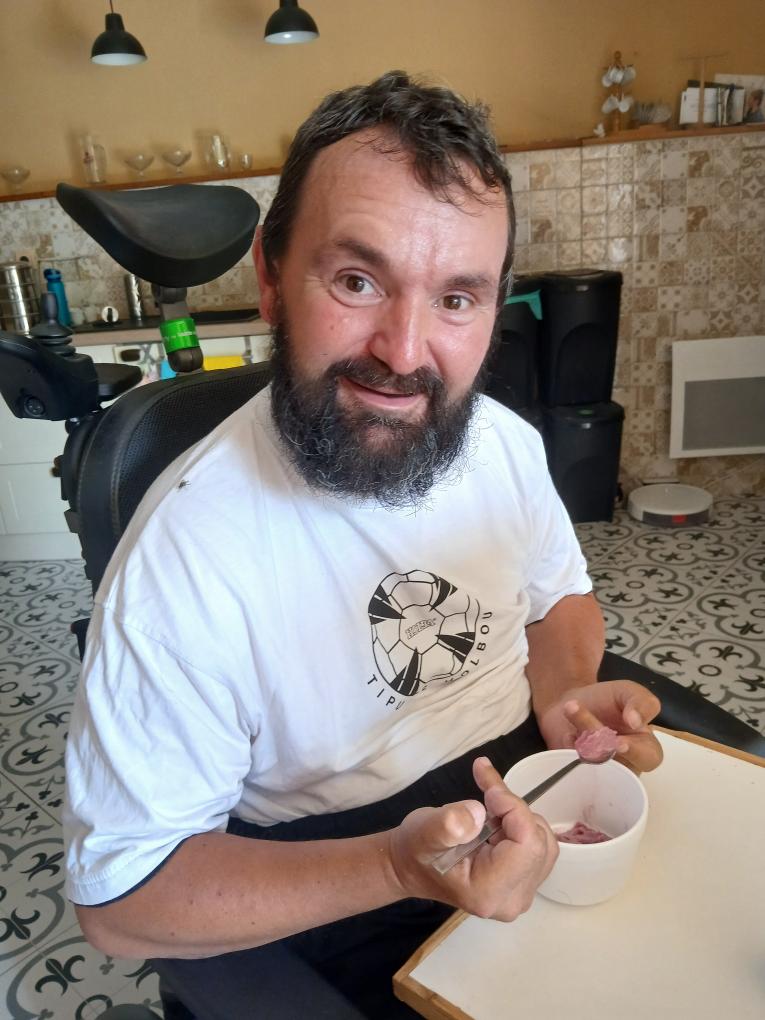
The following interview was conducted by email in the spring of 2026. In it, Kamil describes his life with a condition that left him bedridden in 2017.
At the beginning of the interview and throughout it, I have taken the liberty of quoting several passages from Kamil’s forthcoming autobiography, which help paint a fuller picture of his life before and after the stroke.
“The thing was, I didn’t know how to switch off. An interrogation didn’t stop me. A dismantled car didn’t stop me. Exhaustion didn’t stop me. Maybe I was living life with my foot flat on the accelerator. Maybe sometimes I pushed the speed limit too far.
Looking back, it almost seems as though fate and I had a personal agreement. It threw obstacles in my path, and I used them as fuel.
My life was never a straight road. It was rough terrain. Mud, potholes, the occasional explosion.
But you know what? I never stayed down. Every blow slowed me down, but it never stopped me. Every fall taught me to get back up faster.
Maybe I was a magnet for trouble. But I was also a magnet for survival. Life kept testing me. Testing how much I could take. And every time, my answer was the same. I got back up. Dusted myself off. And kept going.”
What do you remember about the day you had your stroke?
I remember waking up during the night and being unable to move. I was left paralysed in all four limbs. The areas of my brain responsible for speech were affected, as were the muscles I needed for chewing. From that moment on, I was trapped inside my own body.
“I lay there. I could hear everything. I understood everything. And I couldn’t give even the slightest sign that I was conscious.”
I was completely aware of everything going on around me, but nobody knew it. Those were the worst moments of my life.
After three months, a speech therapist noticed that I was responding with my eyes, and I began communicating with the people around me using a gaming bar connected to a computer. By blinking my eyes, I was able to write an email and communicate with others. I finally felt like a human being again.
How did the stroke affect the rest of your life?
My life changed completely. I went from being a hardworking man who never let anything stop him and who worked day and night to someone completely dependent on the care of others.
And what is your life like today?
Today, I live alone in a fully accessible house. I make extensive use of modern technology and control many things through my mobile phone. I can vacuum and mop the floors using a robotic vacuum cleaner; open, close, and lock the doors; lower the blinds; turn the lights on; and switch on the heating.
During the week, lunches are delivered to me from Bohuslavice, and at weekends my mother cooks for me. Carers and nurses come to see me and help me into my wheelchair and onto my MOTOmed, which passively exercises my arms and legs. They also help me empty the dishwasher or take the laundry out of the washing machine; whatever happens to be needed. Twice a year, I arrange for professional cleaning.
And I’m slowly beginning to communicate verbally again. I speak slowly, but I can make myself understood. I can say what I need.
How did you come to terms with what happened to you?
I simply appreciate what I have, because things used to be much worse. Right now, there isn’t really anything I would significantly change. It takes a huge amount of work to keep living at home rather than moving into an institution. But I’ve always been someone who wasn’t used to lying around doing nothing, and having responsibilities helps keep my mind clear. I don’t have time to be depressed. I don’t take any psychiatric medication either. I simply appreciate what I have. Things have been worse.
“Today I know that the greatest battle wasn’t with the authorities. Or even with the illness. It was with myself. With self-pity. With fear. With the idea that my life was over.”
How did the people around you react to your stroke, and who supported you the most?
The people closest to me – my former wife and my whole family – came together and supported me.
“Today, I can’t afford to let up. As soon as I skip exercising, my body stiffens. Rehabilitation isn’t a choice for me; it’s a necessity. It’s how I hold on to everything I’ve fought for and stop another piece of myself from being taken away.”
What advice would you give to people with acquired brain injuries?
Keep going and live as fully as you can, because life is beautiful.
How has your outlook on life changed?
My desire to live knows no bounds. I appreciate people who are helpful and willing to support me much more than I used to.